The .si Land Rush Explains Nothing About Naming an AI Company
Trump called AI "super intelligence" at the UN, and Slovenia's domain registry nearly broke. We looked at what actually happened — and why copying the acronym is the wrong lesson to take from it.
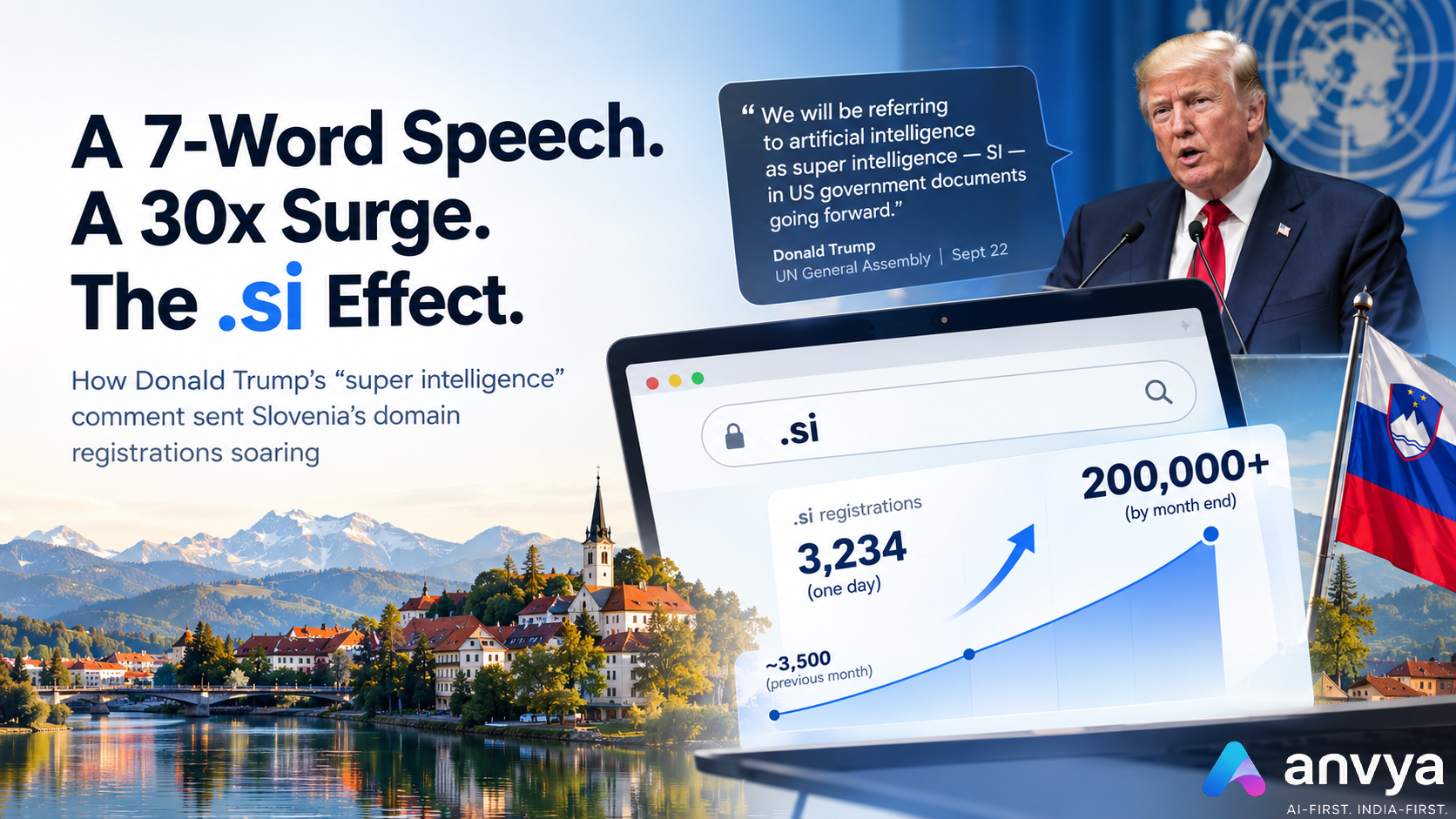
On September 22, Donald Trump told the UN General Assembly that artificial intelligence would be referred to as "super intelligence" — SI — in US government documents going forward. The next day, Slovenia's domain registry recorded 3,234 new .si registrations, more than 30 times a normal day. By the end of the month, total registrations had surged past 200,000, up from roughly 3,500 the month before.
That's not a rounding error. That's a seven-word line in a speech moving a national registry's numbers more than any marketing campaign Slovenia has ever run.
Why .si, specifically
Slovenia's country-code domain has nothing to do with artificial intelligence. It exists because Slovenia exists. But ".si" happens to spell out "super intelligence" the same way ".ai" spells out "artificial intelligence," and anyone who lived through the .ai land rush recognised the shape of it instantly: a short, pronounceable ending that announces what you do before anyone reads the name in front of it.
.si has one practical advantage over .ai that got buried under the headlines: it only needs a one-year registration. .ai requires two. If you're speculating on domain inventory rather than building something, that difference matters more than the politics around it.
The part everyone skipped
"Super intelligence" didn't start with a presidential speech. Ilya Sutskever named his company Safe Superintelligence back in 2024. Meta built an entire research division called Meta Superintelligence Labs and spent over fourteen billion dollars acquiring Scale AI's Alexandr Wang to run it. In May, three researchers — Tim Rocktäschel, Richard Socher, and Jeff Clune — raised $650 million for a company named, plainly, Recursive Superintelligence, at a $4.65 billion valuation, and bought recursive.si as their domain months before anyone outside the industry was paying attention.
The vocabulary shift was already underway among the people actually building the thing. The UN speech didn't invent the term — it took a word researchers had been using for a year and handed it a microphone loud enough to reach every domain speculator who's never read a single line of Sutskever's work.
What this means if you're naming something right now
Almost nothing, and that's worth saying plainly. A domain extension has never made a company's technology better, and it won't start now. .ai didn't turn a thin chatbot wrapper into a foundation-model company, and .si won't do that for whatever comes next. What an extension can do is signal category in the half-second before someone reads your actual name — real, but small, and entirely dependent on that name being good on its own merit.
If you're choosing a name this month, check .si the way you'd check .ai or .co: as one more place to register, not as a strategy. A name that's hard to say, hard to spell, or already trademarked is still a bad name, no matter which three letters follow the dot. The .si rush will look, in a year, the way the .ai rush looks now — mostly forgotten, except for the handful of companies that would have been named well regardless of which domain they ended up buying.
For what it's worth: our free business name generator now checks .si alongside .com and .in when you're brainstorming. Use it to save a search, not to pick a strategy — the name still has to work without the suffix doing the job for it.